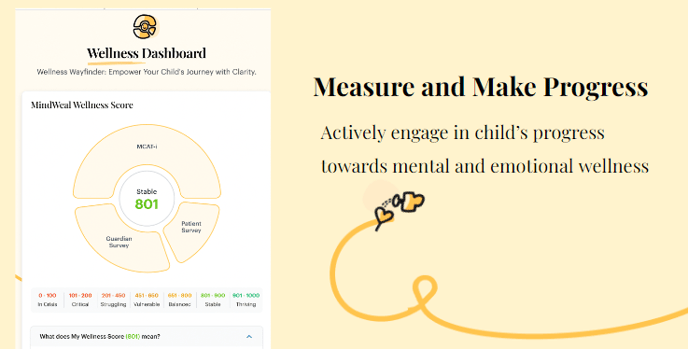
The MCAT features 17 domains, with 11 containing intensity-based questions. Providers' responses to these questions generate the MCAT-i Score, which directly impacts the Wellness Score.
This is how Wellness score is displayed on Patient's dashboard:
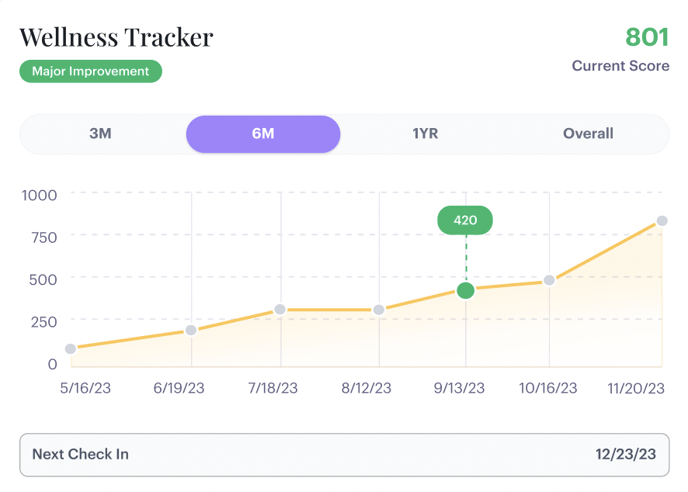
This is how the Wellness tracker is showcased on the app:
Click HERE to learn more about Patient's experience with Wellness Score
Purpose of Wellness Score
The Wellness Score is displayed on the patient's dashboard and serves several important purposes:
- Tracking Progress: Patients can monitor their improvement over time.
- Evaluating Treatment: Providers assess the effectiveness of the treatment plan.
- Triggering Interventions: MindWeal identifies when additional support or a supervising psychiatrist's input may be required.
Standardizing Symptom Intensity Scoring
To ensure consistent and reliable scoring, MindWeal has developed a standardized method for evaluating symptom intensity. This approach improves inter-rater reliability, ensuring scores are accurate and actionable across providers.
Two Types of Intensity Questions
The MCAT intensity questions are divided into two types:
- Severity-Based Intensity: Assesses how severe the symptoms are.
- Frequency-Based Intensity: Measures how often the symptoms occur.
Severity-Based Intensity
| Level of Intensity | Score | Description of Intensity Level (Severity of sx., manageability, impact on daily life) | Intervention needed |
| No symptoms | 0 | Child has not been experiencing any noticeable symptoms | None |
| Minimal | 1 | Child has very few/rare or barely noticeable symptoms that have no impact on their daily life. | None |
| Mild | 3 | Child has some/occasional symptoms that are easily manageable and not greatly/minority affecting their daily activities but overall performance is maintained, doesn't hinder adaptability, with no difficulty in managing to cope | Recommend adding to or increasing current treatment (e.g., starting therapy, increasing therapy frequency, starting medication, or adjusting medication dosage). However, if the patient prefers to wait before taking these additional steps, it is acceptable to closely monitor symptoms for now, based on patient preference. |
| Moderate | 5 | Symptoms are regular/clearly evident, somewhat difficult to manage & require attention with noticeable impact child's daily life and regular activities. | Initiating or increasing medication is recommended at this stage, independent of therapy recommendations (such as adding therapy, continuing therapy, or increasing therapy frequency). |
| Severe | 8 | Symptoms are significant/challenging/frequent, very difficult to manage and have a considerable impact on your child's daily life/regular disruptions in daily life | Medication initiation or dose increase is strongly recommended at this stage. Depending on the severity and type of mental health concerns, consideration of a higher level of care, such as Intensive Outpatient Programs (IOP) or Partial Hospitalization Programs (PHP), may also be appropriate. |
| Very Severe | 10 | Symptoms are extremely high/overwhelming/constant, surpassing any previous levels, severely impacting daily life, profoundly hindering (not able to do daily activities, incapacitating/debilitating, requiring immediate care/ urgent attention | highest level of care needed for the patient's safety and stabilization, hence Inpatient hospitalization is recommended |
Frequency-Based Intensity
| Level of Intensity | Score | Description of Intensity Level (Severity of sx., manageability, impact on daily life) | Intervention needed |
| Not at All | 0 | No episodes/no incidents in the last month | None |
| Rare Occurrences | 2 | Isolated episodes, just once or twice in the last month, no impact on their daily life | None |
| Occasional: | 4 | A few (3-4) episodes in the past month, easily manageable, not greatly affecting daily life | Therapy, meds as per patient's preference |
| Frequent | 6 | Several episodes each week, somewhat difficult to manage & require attention with noticeable impact child's daily life and regular activities. | Meds Recommended |
| Nearly Daily | 8 | Almost daily occurrences, very difficult to manage and have a considerable impact on your child's daily life/regular disruptions in daily life | Meds strongly recommended |
| Multiple Daily Episodes | 10 | Extremely frequent, numerous daily occurrences, constant concern, surpassing any previous levels, severely impacting daily life, profoundly hindering (not able to do daily activities, incapacitating/debilitating, requiring immediate care/ urgent attention | Immediate med change and close follow-up recommended |